

|
Criterion |
SoftSmile VISION |
3Shape Ortho System |
DentalMonitoring |
Invisalign ClinCheck Pro |
CephX AI |
|
1. Clinical Accuracy and Validation |
AI neural networks, machine learning, improves with each case |
ICC 0.752-0.993, excellent reliability, clinically acceptable |
FDA De Novo 2024, 2,650+ patients, 15+ indications |
High ICC for tooth widths but 41-50% prediction accuracy |
FDA-cleared, AI neural networks, 3D CBCT auto-segmentation |
|
2. Diagnostic and Planning Features |
3D CBCT, segmentation, virtual planning, aligner and attachment planning |
3D modeling, OrthoAnalyzer, 600+ bracket libraries |
Remote AI monitoring, real-time tracking, SmartSTL |
3D visualization, Bolton analysis, 3D attachment placement |
2D ceph tracing, 100+ analyses, 3D CBCT, airway analysis |
|
3. Cost (Initial + Ongoing) |
$199/month doctors, $1,000/month labs, $60/case |
$8,000-15,000 initial, ~$13,500 in Europe |
Not publicly disclosed, included in treatment |
€290 ClinCheck, $3-5k US Invisalign treatment |
$59-399/month tiered plans, $1 promo |
|
4. Integration and Compatibility |
Any scan formats, CBCT, cloud WebViewer |
Open STL, 3Shape TRIOS scanner, 600+ compatible systems |
Smartphone app, Invisalign workflow, ScanBox |
Invisalign ecosystem, iTero scanner (3Shape) |
Cloud web-based, all formats, Planmeca, Dentsply |
|
5. Usability and Support |
Web interface, 6-10 min processing time |
Professional software, Intel i7+32GB RAM, NVIDIA GPU |
Simple selfie UI for patients, web dashboard |
Intuitive, requires training, Align Technology support |
Simple cloud diagnostic UI, web based |
November 17, 2025
Top 5 AI Orthodontic Software Solutions Transforming Digital Treatment Planning in 2025

SoftSmile Team

Artificial Intelligence (AI) is rapidly redefining how orthodontists design, evaluate, and execute treatment plans. From automating tooth segmentation to predicting patient outcomes, AI-driven orthodontic software has evolved into a vital tool for clinics looking to improve accuracy, efficiency, and patient satisfaction.
Who This Article Is For
This article is written for orthodontists and general dentists in private practices and group dental clinics who are evaluating AI tools for diagnostics, treatment simulation, and workflow automation. If you are looking to move from conventional setups toward fully or partially digital orthodontic workflows, this guide will help you compare leading AI solutions and understand where they fit into your practice.
It is also relevant for hospital-based dental departments and academic or research institutions that work with complex orthodontic cases or train the next generation of clinicians. These organizations are often early adopters of AI, using it to validate protocols, standardize treatment quality, and integrate advanced imaging and analytics into education and research.
Finally, this article will be useful for dental laboratories, teleorthodontic providers, and other stakeholders involved in designing, fabricating, or remotely supervising orthodontic treatment. For these groups, understanding the capabilities and limitations of top AI platforms is essential for building efficient collaboration with clinics, scaling services, and aligning with evidence-based, outcome-driven orthodontic care.
1. SoftSmile VISION Review

SoftSmile VISION is a modern digital orthodontic platform that uses advanced AI and machine learning to deliver accurate, efficient, and scalable treatment planning. Designed for both clinics and orthodontic labs, it focuses on precision, automation, and workflow speed, making it one of the best ai orthodontic software options for practices of all sizes.
Clinical Accuracy and Validation
VISION is powered by neural networks trained on large CBCT datasets. Its machine learning engine refines segmentation and prediction accuracy with every new case. This results in consistent tooth detection, stable anatomical interpretation, and minimal manual adjustments. Clinicians benefit from:
-
Reliable CBCT-based accuracy
-
Automated segmentation that reduces planning time
-
Predictable movement simulations supported by data VISION’s consistency makes it ideal for teams seeking strong ai driven orthodontic treatment planning software.
Diagnostic and Planning Features
The platform includes everything needed for end-to-end treatment planning. Key tools include:
-
3D modeling from CBCT and intraoral scans
-
Automatic tooth segmentation
-
Treatment simulations with precise staging
-
Attachment and aligner setup
-
Batch processing for labs The workflow is fast, intuitive, and built for efficiency, which positions VISION as a competitive ai orthodontic treatment planning software solution.
Pricing
SoftSmile offers flexible pricing designed to scale:
-
$199 per month for clinics
-
$1,000 per month for labs (15 cases)
-
$60 per case
-
$120 to $200 per professional design case This flexibility gives VISION one of the strongest cost-to-capability ratios in the market.
Integration and Compatibility
VISION works fully in the browser and supports CBCT, STL, PLY, OBJ, and DICOM. Cloud access and WebViewer collaboration make communication between doctors and labs seamless.
Ease of Use
The interface is simple, visual, and fast. Most cases process in 6 to 10 minutes, with experienced users completing workflows in about 5 minutes. Regular updates and accessible support keep the platform smooth for everyday use.
2. 3Shape Ortho System Review

3Shape Ortho System is a well-established solution widely used by orthodontists who need a reliable and fully-featured planning environment. While it is not primarily AI focused, it provides a strong, clinically validated foundation for orthodontic diagnostics, appliance setup, and digital workflows.
Clinical Accuracy and Validation
3Shape is known for high measurement reliability, with ICC values ranging from 0.752 to 0.993 for tooth width and arch measurements. This level of accuracy establishes the software as a trustworthy diagnostic tool. You can expect:
-
Stable reproducibility across operators
-
Accurate digital model creation
-
Clinically acceptable diagnostics comparable to plaster models Although not as AI heavy as newer platforms, its reliability makes it suitable for clinics looking for the best ai software for orthodontic treatment when combined with external AI tools.
Diagnostic and Planning Features
The platform includes specialized modules for orthodontic workflows:
-
OrthoAnalyzer for measurements and 3D diagnostics
-
Indirect Bonding Studio with 600 plus bracket libraries
-
Appliance Designer for custom devices
-
STL-based segmentation and analysis These tools support a full digital orthodontic ecosystem that integrates brackets, aligners, and appliances in a single planning environment.
Pricing
3Shape Ortho System requires a significant upfront investment:
-
$8,000 to $15,000 depending on configuration
-
Cloud features typically included in the package This model suits clinics that prefer a one-time purchase rather than subscription-based licensing.
Integration and Compatibility
3Shape supports open-format STL files and integrates seamlessly with TRIOS scanners and 3Shape Communicate for case sharing. It also connects with 600 plus manufacturer systems, making it extremely versatile.
Ease of Use
The interface is professional but requires onboarding and hardware capable of handling 3D workloads, such as Intel i7 processors and dedicated NVIDIA GPUs. Once configured, the workflow is stable and dependable for daily orthodontic use.
3. DentalMonitoring Review

DentalMonitoring is a leading platform for AI powered remote orthodontic monitoring. Rather than functioning as traditional treatment planning software, it focuses on continuous patient oversight through smartphone captured images. It is a valuable complement to in office systems, enabling clinicians to track progress, detect issues early, and reduce unnecessary visits.
Clinical Accuracy and Validation
DentalMonitoring is the first remote monitoring software to receive FDA De Novo clearance, supported by large scale clinical validation. Its AI was trained on data from more than 2,650 patients, 29 research sites, and over 13,000 clinical outcomes. Key capabilities include detection of:
-
Aligner fit issues
-
Bracket debonding
-
Open bite and overjet changes
-
Tooth movement irregularities
-
Inconsistent wear patterns Its proven accuracy makes it one of the most reliable ai orthodontic software solutions for ongoing patient supervision.
Diagnostic and Monitoring Features
DentalMonitoring focuses on real time treatment oversight rather than full treatment planning. Core functionalities include:
-
AI analysis of intraoral photos and videos
-
SmartSTL requests to update digital models
-
Alerts for more than 15 clinical indicators
-
Tracking of tooth movement and aligner progress
-
Remote patient instructions and communication This system helps clinicians maintain precise control over treatment without increasing chair time.
Pricing
DentalMonitoring does not publicly disclose its pricing. Typically, it is bundled into overall orthodontic treatment fees. Studies show clinics using DM can reduce in office visits by up to 33 percent, making it a cost effective addition for high volume aligner practices.
Integration and Compatibility
DentalMonitoring works via a smartphone app compatible with iOS and Android. The cloud based dashboard integrates with Invisalign workflows and supports ScanBox Pro for structured imaging. It fits into most digital orthodontic systems without requiring hardware upgrades.
Ease of Use
For patients, usage is simple: take guided photos in the app. For clinicians, the web dashboard organizes alerts, trends, and case metrics clearly. The platform is designed for patients as young as six and includes continuous support and updates.
4. Invisalign ClinCheck Pro Review
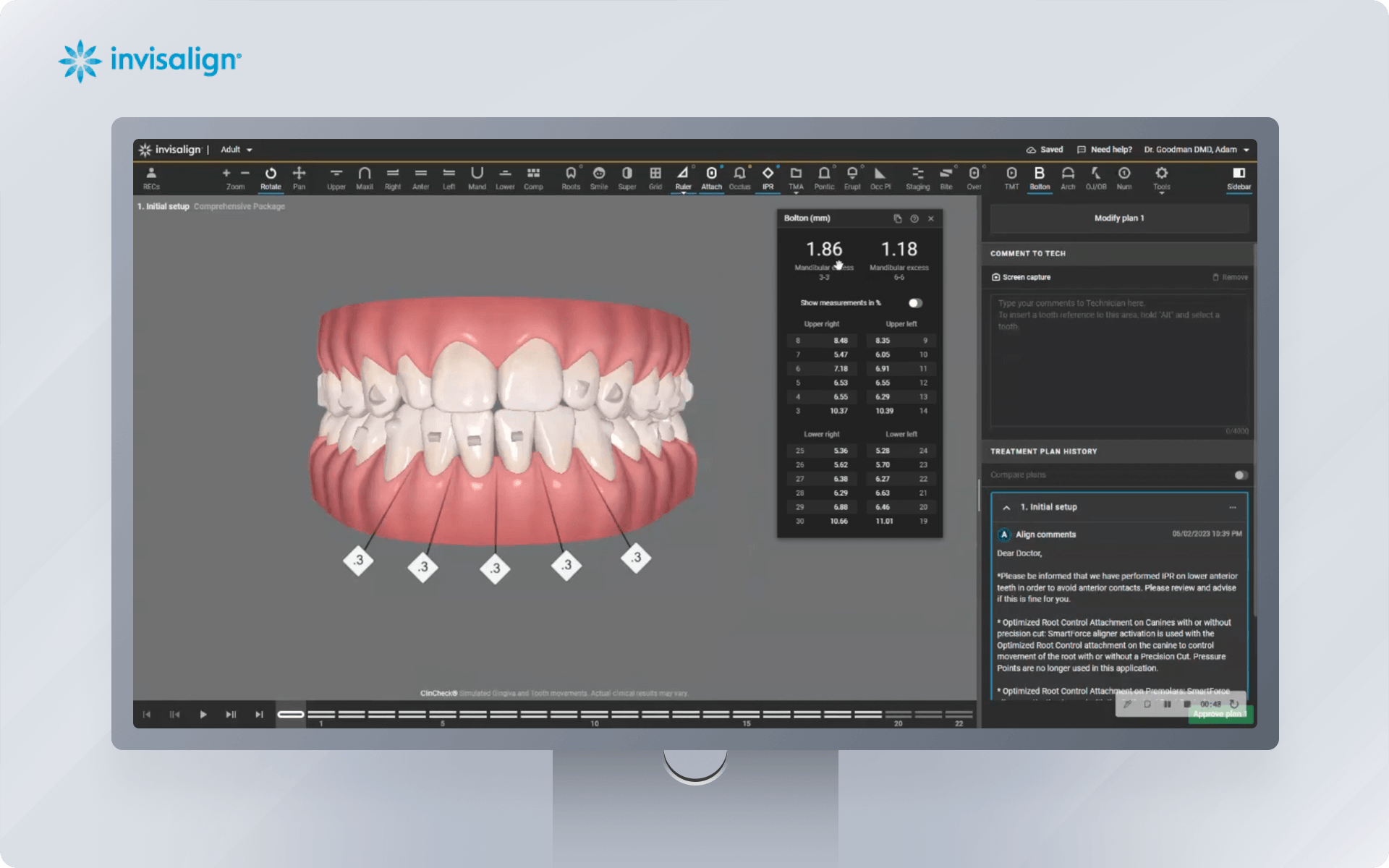
Invisalign ClinCheck Pro is a core component of the Invisalign ecosystem, offering advanced 3D treatment planning for practices using the Align Technology workflow. While it includes intelligent automation, it is not a fully AI driven platform compared to newer competitors. However, it remains the industry standard for Invisalign case planning.
Clinical Accuracy and Validation
ClinCheck provides high reliability in fundamental orthodontic measurements, especially tooth width calculations, supported by strong ICC values. However, several clinical studies highlight known limitations:
-
Underexpression of rotations
-
Reduced accuracy in torque correction for central incisors
-
Overall tooth movement prediction accuracy of 41 to 50 percent Despite these limitations, ClinCheck remains the most widely used planning tool for Invisalign treatments due to its seamless integration and large clinical dataset.
Diagnostic and Planning Features
ClinCheck Pro supports a complete Invisalign treatment setup with tools such as:
-
3D visualization and simulation
-
Detailed staging of tooth movements
-
Bolton analysis with minimal margin of error
-
Attachment placement with 3D previews
-
Orthogonal projection for precise measurements These features enable clinicians to create predictable and patient specific aligner plans tailored to Invisalign biomechanics.
Pricing
ClinCheck Pro is not sold separately. Instead, the planning cost is part of the Invisalign treatment fee:
-
€290 per workup in many regions
-
Total treatment costs ranging from $3,000 to $5,000 in the US and €1,280 to €5,700 in Europe This pricing structure aligns ClinCheck with the broader Invisalign service model.
Integration and Compatibility
ClinCheck integrates exclusively with the iTero scanner and the Invisalign cloud ecosystem. Because of this closed architecture, it is not ideal for clinics seeking open format workflows.
Ease of Use
ClinCheck Pro offers a clean interface and intuitive 3D tools. It requires training to fully master, but support from Align Technology is included. Once learned, the system is fast, stable, and well suited for everyday Invisalign case management.
5. CephX AI Review

CephX AI is a cloud based orthodontic analysis platform focused on fast, automated cephalometric interpretation for both 2D radiographs and 3D CBCT scans. Unlike full treatment planning systems, CephX specializes in diagnostics, making it an excellent companion tool for practices that need accurate ceph analysis without investing in heavier planning software.
Clinical Accuracy and Validation
CephX uses FDA cleared AI models for cephalometric landmark detection and tracing. Its algorithms are trained on extensive radiographic datasets to deliver consistent results with minimal manual adjustments. Clinicians benefit from:
-
Automated 2D cephalometric tracing covering more than 100 analysis types
-
AI enhanced airway evaluation
-
Reliable 3D CBCT segmentation using neural networks
-
Multilingual cloud architecture that maintains accuracy across different imaging sources Its strength in diagnostics makes it a valuable orthodontic ai software option for clinics that require high speed analysis.
Diagnostic and Planning Features
Although CephX is not designed for full aligner planning, it provides robust tools for measurement and clinical assessment. Key features include:
-
Automatic tracing of lateral ceph images
-
3D CBCT analysis with auto segmentation
-
Superimposition for growth and treatment comparison
-
STL export and built in 3D viewer
-
Detailed profile overlays and airway volume data This functionality supports orthodontists in building accurate diagnostic baselines before creating a treatment plan in other systems.
Pricing
CephX is one of the most affordable platforms in this comparison. Subscription tiers include:
-
Basic 2D at $59 per month for 3 cases
-
Advanced 2D at $119 per month for 10 cases
-
Pro 2D at $159 per month for 50 cases
-
Pro 3D at $249 to $399 per month for 10 to 50 CBCT cases A promotional offer includes the first month plus one analysis for $1.
Integration and Compatibility
CephX is fully cloud based and supports all major radiographic formats. It integrates well with systems like Planmeca and Dentsply Sirona and includes multilingual support for international practices.
Ease of Use
The interface is simple, quick to learn, and entirely web based. Since heavy processing happens on the cloud, local hardware requirements are minimal. CephX is ideal for clinics that want fast, automated diagnostics without complex setup.
Orthodontic Market Share
The global market for AI-driven orthodontic treatment planning has already passed the billion-dollar mark and is growing at more than 20% annually, driven by rising demand for digital diagnostics, remote monitoring, and personalized aligner therapy. Most of this spending still comes from practices that are upgrading from traditional, model-based workflows to fully digital ecosystems built around 3D imaging, CBCT, and cloud software.
Today, established vendors such as Invisalign (ClinCheck Pro) and 3Shape command the largest installed base, thanks to their long presence in digital orthodontics and tight integration with proprietary scanners and lab workflows. At the same time, specialized platforms are rapidly gaining share in high-growth niches: DentalMonitoring in AI-powered remote supervision, CephX in automated cephalometric analysis, and SoftSmile VISION in open, scanner-agnostic 3D treatment planning.
For clinics and labs, this shift in market share reflects a deeper change than just “new software.” Providers that adopt AI tools early are moving toward more scalable, data-driven care models, with higher case throughput, fewer chairside adjustments, and more predictable outcomes. The comparison chart above visually summarizes how the five leading solutions in this article line up across accuracy, features, cost, integration, and usability—helping practices understand where each platform fits in the evolving AI orthodontic landscape.
Why is AI important for orthodontics?
AI closes the gap between what clinicians can realistically do in a busy schedule and what is technically possible with today’s imaging and data. Manual cephalometric tracing, CBCT segmentation, bracket positioning, and aligner staging are all precise but repetitive tasks that consume hours of chairside and back-office time. By automating these routine steps, AI frees orthodontists to focus on clinical judgment, complex cases, and patient communication rather than pixel-level work on every scan.
Just as important, AI brings a new level of consistency and predictability to digital treatment planning. Algorithms trained on thousands of cases can detect patterns, simulate movements, and flag risks that are easy to overlook in a purely manual workflow. This translates into more stable treatment plans, earlier detection of issues, and better control over outcomes—especially in aligner-based and multidisciplinary cases where small errors can compound over time.
Finally, AI is now central to how modern patients experience orthodontics. From real-time treatment simulations to remote progress monitoring, AI-driven tools help patients see, understand, and stay engaged with their treatment journey. Clear visuals, measurable milestones, and fewer unnecessary appointments all contribute to higher satisfaction and better adherence. In this sense, AI is not just a “nice-to-have” technology layer, but a core enabler of scalable, patient-centric orthodontic care


The Future of AI in Orthodontic Treatment Planning
As artificial intelligence continues to evolve, the field of orthodontics is undergoing a profound transformation. What once required extensive manual effort - from diagnostics to aligner setup - is now being accelerated, optimized, and personalized through AI orthodontic software. These technologies not only save valuable clinical time but also elevate treatment accuracy, patient experience, and long-term outcomes.
The five platforms featured in this review - SoftSmile VISION, 3Shape Ortho System, DentalMonitoring, Invisalign ClinCheck Pro, and CephX AI - each represent a unique step toward smarter, data-driven orthodontics. Together, they demonstrate how AI-driven orthodontic treatment planning is becoming the new standard of care in digital dentistry.
Among them, SoftSmile VISION stands out as the most comprehensive and forward-thinking solution. By integrating advanced machine learning, real-time collaboration tools, and a conversational AI assistant, VISION not only accelerates treatment planning but also reshapes how clinicians interact with technology. Its balance of automation and human oversight reflects a deep understanding of both the technical and ethical dimensions of modern orthodontic practice.
Looking ahead, we can expect further innovation as AI becomes even more deeply embedded in diagnostic imaging, predictive analytics, and patient engagement. However, the future of AI in orthodontics will depend not only on technological advancement but also on responsible implementation - ensuring transparency, accuracy, and patient trust at every step.
For orthodontists seeking the best ai software for orthodontic treatment in 2025, SoftSmile’s VISION represents the perfect intersection of precision, performance, and practicality - a true leader in the next generation of digital orthodontic care.
SoftSmile Team


Sign up for our newsletter!
Case Studies, Podcasts, Ebooks, Events, Webinars, Company news, and more...
By subscribing you agree to the Terms of Use and Privacy Policy.